
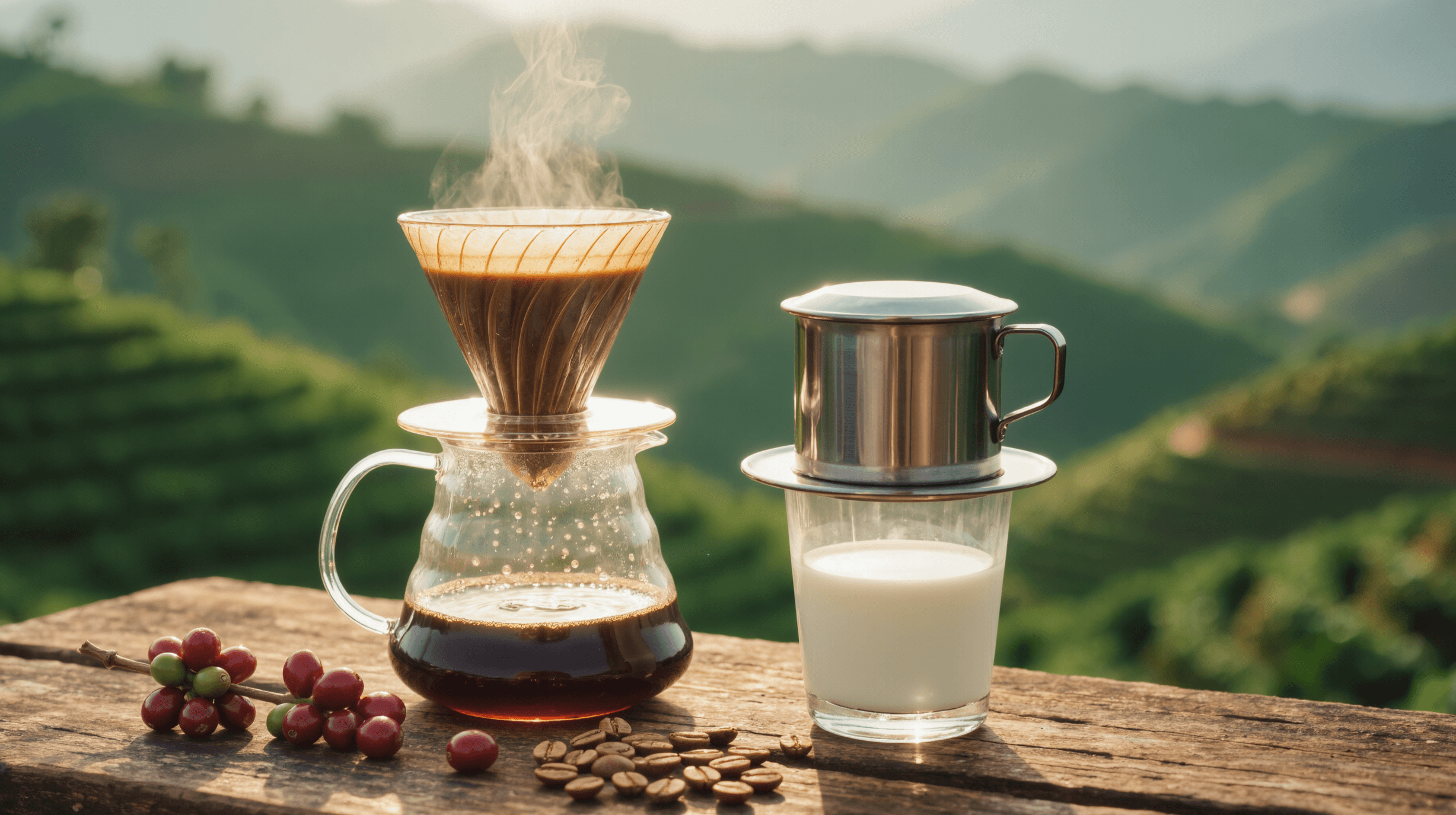
Most people I’ve talked to think Vietnam only produces Robusta coffee. They’re surprised when I tell them Vietnam also grows Arabica, including specialty grades!
Whenever I tell people I brew my Vietnamese coffee on a V60, I get the same reaction: "Won't that taste a bit strong for Robusta?"
Interestingly, most people I've talked to assume Vietnam only grows Robusta. They're quite surprised to hear that Vietnam also grows Arabica, and that some of it is good enough to be called specialty!
That assumption isn't silly. It comes from real numbers, a long history and, here in Singapore, the way most of us first met Vietnamese coffee. Let's unpack all three!
Because, by volume, it mostly is. Vietnam is the world's second-largest coffee producer after Brazil, and roughly 97% of what it grows is Robusta.
The 2025/26 forecast puts Vietnam's crop at about 31 million 60-kg bags. Around 30 million of those are Robusta. Only about 1 million are Arabica, just a little over 3%! (Daily Coffee News, citing USDA). Of course, there is a small production of Liberica coffee too ~
Most of that Robusta comes from the Central Highlands (Đắk Lắk, Gia Lai, Lâm Đồng), which hold about 92% of the country's coffee land. The Arabica grows elsewhere, mostly in the cool northern mountains of Sơn La and around Đà Lạt.
So when someone hears "Vietnamese coffee," they're picturing the 97%. The 3% just doesn't get talked about much.
In Singapore, we grew up on kopi. Kopi is also strong, dark and sweet, and it's made mostly from Robusta (but from Indonesia instead). So when we first taste Vietnamese coffee, it feels familiar, and that familiarity is what fixes the idea in our heads.
The Robusta roots go all back to the 1880s. When coffee-leaf rust epidemic wiped out Java's Arabica farms between 1880 and 1883, and Dutch planters switched to hardier, cheaper Robusta (Singapore Chinese Cultural Centre). Hainanese roasters here then fried the beans with margarine, sugar and a pinch of salt to tame the bitterness. Condensed milk softened the cup further -- Our daily kopi from hawkers.
How most Singaporeans meet Vietnamese coffee - a cà phê sữa đá on a trip to Ho Chi Minh City, Hanoi, or at any Vietnamese café back home. It's dark-roasted Robusta, dripped slowly through a phin, over condensed milk and ice. To a kopi drinker it tastes like a close cousin of kopi peng.
Vietnamese coffee is also still a small player on our shelves. In 2023 it made up only about 2.2% of Singapore's coffee imports, behind Malaysia, Indonesia.(Việt Nam News). With so little of it around, Singaporeans rarely get a chance to try anything other than the classic.
Hence, we see two strong, dark, sweet coffees, two condensed-milk traditions and two Robusta stories, sharing the similar taste. It's no wonder "Vietnamese coffee = Robusta"
But! Here's the twist: Vietnam's first coffee was actually Arabica, not Robusta. French missionaries brought it in the mid-1800s, and Robusta only arrived about 50 years later (Sucafina).
| When | What happened |
|---|---|
| 1857 | French missionaries bring the first coffee plants to Vietnam |
| 1888 | First plantations in Ninh Bình and Quảng Bình, mostly Arabica |
| Early 1900s | The French trial Arabica in Sơn La, at Hua La, Mai Sơn and Thuận Châu |
| 1908 | Robusta and Excelsa arrive in the Central Highlands |
| 1914–1920s | Buôn Ma Thuột becomes a Robusta plantation hub, with the beans shipped to France |
| 1986 | Đổi Mới reforms open the economy, and Robusta planting booms |
| 1994 | A state programme replants Arabica on Sơn La's bare hills to fight poverty |
| Late 1990s | Vietnam becomes the world's No. 2 coffee producer, behind Brazil |
However, Robusta won for practical reasons. It grows well in the warm, low Central Highlands, yields more and resists disease. After Đổi Mới, the government backed it with state farms and new hybrids. Until about 1989 the state also bought all coffee at fixed prices, so farmers had little reason to chase quality or grow Arabica.
Arabica survived in the cooler mountains. In Sơn La it nearly disappeared again around 2014–2015. Fresh coffee cherries were sold at a price lower than it costs to grow it, and many farmers switched to corn and fruit trees. What brought it back was a shift towards quality: co-ops, longer fermentations and specialty buyers.
Vietnamese Arabica grows in the mountains, mostly in Sơn La and Điện Biên in the north and Lâm Đồng (Đà Lạt) in the south. Sơn La is the biggest Arabica region in the country.
Where it grows. Sơn La's Arabica sits at roughly 700–1,200 m. Its days are mild and nights are cool, which slows ripening and builds sweetness. Harvest runs from about October to January, so the new crop is being picked right now!
What it tastes like. Natural-processed lots lean fruitier: orange, brown sugar and chocolate.
Is it really specialty? Yes! More often than you'd think. At the 2026 Vietnam Amazing Cup, 83% of the 182 entries met specialty standards, and the top Arabica scored 85.3 (QDND). Back in 2020, a Sơn La co-op of just 14 Thai-minority households, Ara-Tay, scored 83 points in its first competition (CARE Vietnam).
It is still a small slice though. Only about 1,120 ha of Sơn La's coffee is managed as specialty (Việt Nam News). Most of the region's beans are still sold as commodity coffee and blended.
A lighter-roasted Sơn La Arabica has more delicate flavours, and a pour-over like the V60 lets the acidity and fruit come through (more of it will come in later posts!).
SO.... Here's my starting recipe:
Drink it black first, so you can taste what the region gives you. And yes, you can still make a Latte with it!
Vietnam really is a Robusta producing country, and kopi drinkers in Singapore have every reason to think so. But the Arabica grown in the highlands do stand out!